
DHI Hair Transplant
DHI (Direct Hair Implantation) is an advanced hair transplant technique. Follicles are implanted directly via a Choi implanter pen — no pre-made channels. Higher density, faster recovery.
100% free, no obligation, reply within 24h
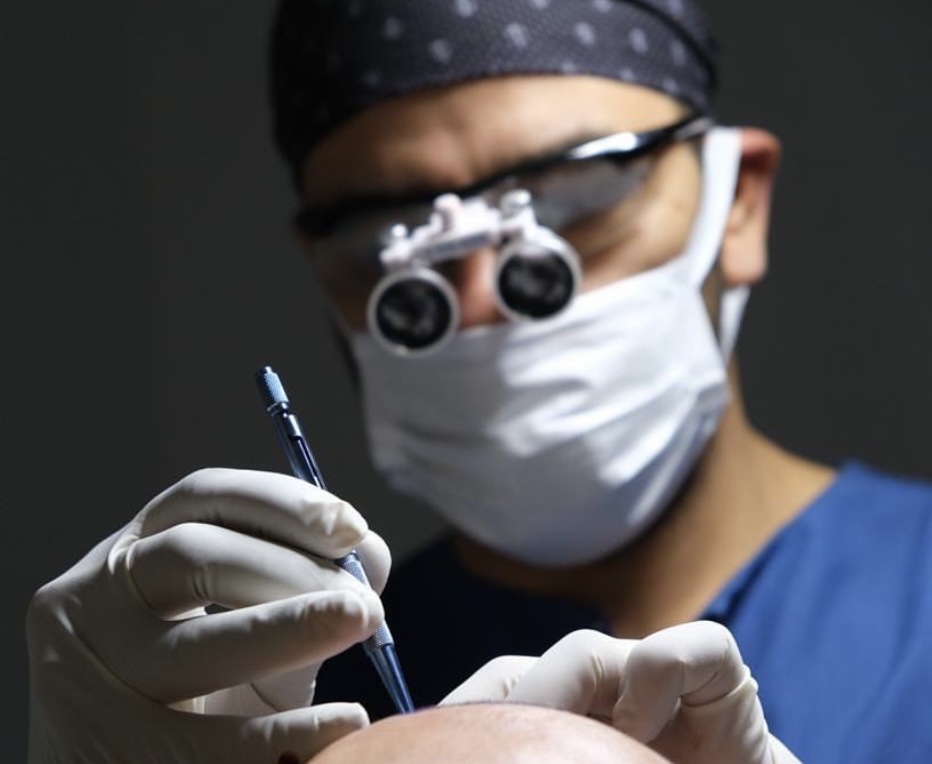
In the treatment room
In DHI the doctor places each follicle directly with the Choi implanter pen. No channels are made in advance, so the follicle spends less time outside the body.
FAQ — Hair Transplant
Answers to the most common questions about hair transplant techniques.
Is a hair transplant painful?
Thanks to local anaesthesia, a hair transplant is virtually painless. You do not feel the procedure itself — the only moment you notice anything is the small injections of the anaesthetic at the start, and they are over quickly.
What you can expect:
- During the procedure: your scalp is fully numbed. You stay awake, you can talk, listen to music or watch a film. You feel neither the extraction nor the implantation.
- The anaesthetic: modern clinics use very fine needles (and sometimes pressure anaesthesia) to make this step as comfortable as possible.
- After the procedure: mild tenderness and sometimes some swelling around the forehead for two to three days. An ordinary painkiller such as paracetamol eases it well.
Most people are mainly surprised afterwards at how manageable it all was. During a free advisory consultation at NIVA CARE, Nico takes you through exactly what to expect, step by step, so you start your treatment with peace of mind.
What is the difference between the FUE and DHI methods?
In both methods your own follicles are harvested one by one from the donor area (the back and sides of the head), without an incision and without a visible scar. The difference lies in how the hairs are implanted.
- FUE (Follicular Unit Extraction): small channels are first made in the area being treated, after which the grafts are placed into them. A proven, widely used technique.
- DHI (Direct Hair Implantation): the follicles are implanted directly with a precision implanter (the Choi pen), without channels made in advance. The doctor therefore sets the exact angle, depth and direction of every single hair.
The advantages of DHI:
- More control over direction and density, for a very natural hairline.
- Higher density is possible, ideal for the hairline and the crown.
- Faster recovery, because the scalp is put under less strain.
The doctor and the university hospital NIVA CARE works with deliberately choose to work with the DHI method only — because it gives the most natural and the densest results. That way you know your treatment uses the most advanced technique available. During a no-obligation advisory consultation, Nico is happy to explain what this means for your situation.
When can I expect to see a result after the procedure?
The full result of a hair transplant is visible after roughly 12 to 14 months. Patience really is your best ally here: hair grows at its own pace.
This is how the journey runs, including with DHI:
- First 2 to 4 weeks: most of the implanted hairs fall out. This “shock loss” phase is entirely normal — the follicles simply stay in your scalp.
- From 3 to 4 months: the first new hairs come through.
- Around 6 months: the difference becomes clearly visible and your hair grows fuller.
- 12 to 14 months: the final result, with full density and a natural hairline.
With DHI in particular you often see a beautiful, dense front edge, because the hairs are implanted precisely and close together. At NIVA CARE, Nico follows your recovery and your hair growth personally until long after you return home, so you always know whether everything is going as it should. Questions about your situation? Feel free to book a no-obligation advisory consultation.
Am I presentable quickly and when can I return to work?
Most people resume their (office) work after roughly 3 to 5 days. So you are back in action fairly quickly, although the procedure does leave visible traces during the first week.
A realistic picture:
- Day 1 to 3: mild redness and some swelling around the forehead. This gradually subsides.
- Day 3 to 5: many people pick up their office work again.
- Day 7 to 14: small scabs in the treated area fall off by themselves. After that you are usually fully presentable again.
- A cap or hat is only allowed after a few days, and even then loosely — so as not to put strain on the freshly implanted hairs.
Do you do physical or heavy work, or work in a dusty environment? Then plan a little more rest. Avoid sweating, sport and heavy exertion during the first weeks. NIVA CARE gives you clear aftercare instructions and Nico stays personally reachable for all your questions. Would you like to know how best to fit this around your work? Let us discuss it during a free advisory consultation.
Does a hair transplant leave scars?
With the modern FUE and DHI techniques a hair transplant leaves no visible scars. Unlike the outdated strip technique (FUT), where a strip of skin was removed, the follicles are now harvested one by one.
What this means:
- No long scar line in your donor area.
- Only microscopic dots where the grafts were taken — virtually invisible to the naked eye.
- These dots fade further and hide under your hair, even with a short cut.
For most people it is afterwards impossible to tell that they have had a hair transplant — which is exactly the point: a natural result. During your advisory consultation, NIVA CARE is happy to show you real examples, so you get a realistic picture.
Is the result of a hair transplant permanent?
Yes, the result of a hair transplant is permanent. The transplanted follicles come from your donor area — hair that is genetically insensitive to the hormone (DHT) that causes hereditary baldness. Those hairs therefore keep growing in their new place for the rest of your life.
One honest caveat:
- The transplanted hairs are retained and grow for life.
- Your existing, non-transplanted hair can still keep thinning, because hereditary hair loss continues.
- That is why NIVA CARE looks at the whole picture beforehand: a considered plan and, where useful, supporting treatments to keep your overall hair density looking good.
That is exactly why honest advice matters so much — sometimes patience or a phased approach is wiser than treating everything at once. Would you like a realistic, transparent picture of what a hair transplant can mean for you in the long term? Book a no-obligation advisory consultation; Nico gives you honest advice, even when that means recommending that you wait a while longer.
What is shock loss?
Shock loss is the temporary shedding of hair after the procedure — both of the implanted hairs and sometimes of surrounding, existing hair. It is a normal reaction of the scalp to the “shock” of the treatment and it is entirely temporary.
Important to know:
- The follicles stay alive — it is only the hair itself that lets go temporarily.
- Within a few months new growth starts up again by itself.
- A regenerative follow-up treatment with exosomes or stem cells can help limit shock loss and support recovery.
Shock loss can be a fright at the time, but it is part of the normal course — it is not a sign that something is going wrong. Nico and NIVA CARE follow your recovery personally, so you know at every moment that everything is going as it should.
How and for how long should I sleep after my hair transplant?
After your hair transplant it is best to sleep on your back, with your head slightly raised, on a neck pillow (a U-shaped travel pillow). You normally do this for the first 7 to 10 days. That protects the freshly implanted grafts on top and relieves the donor area at the back.
Why and how:
- On your back, head slightly raised (about 45°): this reduces swelling and keeps pressure off the treated areas.
- A U-shaped neck pillow: the back of your head rests in the opening, so neither the grafts on top nor the donor area at the back get pressed flat.
- The first 7 to 10 days matter most — that is the period in which the grafts anchor themselves. Out of caution, many people keep it up for around two weeks.
- Avoid sleeping on your side or your stomach during that period, to prevent friction on the grafts.
After about ten days the grafts sit more firmly and you can gradually return to sleeping normally. NIVA CARE gives you clear aftercare instructions, and Nico stays reachable for all your questions during your recovery.
What is the most challenging phase during the treatment?
For many people, harvesting the grafts (the extraction phase) is the least comfortable moment — not because of pain, since your scalp is fully numbed, but because of the position. During this phase you lie on your stomach, so the doctor can easily reach the donor area at the back of your head.
What you can expect:
- During the extraction you lie on your stomach. This is mainly a matter of position and duration, not of pain.
- During the implantation you lie on your back, which most people find considerably more pleasant.
- Breaks are built in, and in the meantime you can listen to music or watch a film to pass the time pleasantly.
Knowing this in advance helps enormously, so nothing takes you by surprise. Because Nico has been through the journey himself, he prepares you honestly for every phase during your advisory consultation — including the moments that ask for a little more patience.
How much does a hair transplant cost on average in Belgium?
In Belgium a hair transplant usually starts from €4,000 for a maximum of 2,500 grafts. The final price depends above all on the number of grafts you need. Important to know: Belgian health insurers do not reimburse a hair transplant.
The final price depends on several factors:
- The number of grafts (the biggest factor): the larger the bald area, the more follicles are needed. Small receding corners already call for 800 to 1,200 grafts; advanced baldness can require more.
- The technique: FUE or DHI.
- The experience of the doctor and the team: an experienced specialist with a strong reputation affects the price — and also the quality of your result.
- The clinic: the facilities, the medical supervision and the aftercare on offer all shape the price.
You can always choose the cheapest option abroad — but that is precisely where the risk sometimes lies. That is where NIVA CARE differs: we work with university hospitals and we arrange personal follow-up after your treatment, with Nico as your fixed point of contact.
And at NIVA CARE it is not only about the transplant itself. We also look at your existing hair and its quality. That is why the doctor we work with also considers complementary therapies — such as exosome and stem cell therapy — alongside your treatment, for a tailored result. Would you like to know what is realistic in your situation? Request a free, no-obligation treatment plan; NIVA CARE gives you a transparent, personalised price.
What are stem cell and exosome therapy?
A hair transplant is really only step one. Implanting the grafts matters, but the ground they land in matters just as much: your scalp has to become, as it were, “fertile soil”. That is why NIVA CARE looks not only at the transplant itself, but also at your existing hair and its quality. The doctor we work with therefore often advises a complementary, regenerative treatment: stem cell therapy or exosome therapy.
Stem cell therapy uses your own body's stem cells. Those cells are able to help repair damaged tissue and “dormant” follicles — a kind of structural reset of the scalp. This treatment takes place the day before your DHI hair transplant and means one extra overnight stay; at NIVA CARE it is included in the package as standard.
Exosome therapy works differently. Exosomes are not cells but microscopic “messengers”, packed with growth factors, peptides and signalling substances. They give your existing cells a powerful, targeted signal to activate hair growth, help curb inflammation and support the blood supply to the follicles. This treatment takes place during your DHI hair transplant.
What this means for you:
- A better environment for the transplanted grafts, aimed at a smoother take.
- Support for your existing hair, not just the new hair.
- Faster recovery and help in limiting temporary “shock loss”.
There is no “one approach fits everyone”. Based on the condition of your scalp, the degree of hair loss and your hair quality, the doctor chooses together with you the therapy that best suits your situation. During a free advisory consultation, Nico is happy to explain what the added value could be in your case.
What is included in a treatment at NIVA CARE?
At NIVA CARE you get an all-in treatment, with no surprises afterwards. The standard treatment — up to a maximum of 4,500 grafts — starts from €2,600. It contains everything you need for a worry-free journey.
What is included as standard:
- The DHI hair transplant at the university hospital (only DHI is used, for the best result).
- Local transport by private taxi (airport, hotel and hospital).
- Two nights in a 5-star hotel.
- Your medication and care products.
- A PRP session (using your own platelets, to support hair growth).
- Personal guidance on site and follow-up after you return home.
A complementary treatment with exosome or stem cell therapy is available at extra cost, for anyone who wants to optimise the result further.
Would you like to know which approach is best for you? For a no-obligation, personal treatment plan you can book a one-to-one conversation with NIVA CARE or attend a group presentation. Nico then calmly goes through every detail with you, so you can make your decision with peace of mind.
Your esthetic journey starts with trust.
100% no obligation — no commitments